EXPLORE A TOPIC

Wellbeing

Wellbeing, adjustment and finding support.

BROWSE BY LOCATION

Across the USA

Find local content and choose whether to include nationwide guidance.

Community perspectives

Public excerpts help visitors understand the topic. These previews contain public community posts. Information you include in a public post may be visible without signing in.

How does American health insurance work? photo
help

How does American health insurance work?

# How does American health insurance work?

## Deductibles, copays and networks explained for South Africans

Reviewed: November 12, 2026

SA Connect editorial guide

If you are used to South African medical aid, some American insurance terms may sound familiar while working differently in practice. A monthly premium does not usually mean every appointment or prescription is fully paid for.

Start with three questions: What do I pay each month? What might I pay when I need care? Which doctors, hospitals and medicines does this particular plan cover?

## Learn the main cost terms

- **Premium:** The amount paid to keep your coverage active, even in a month when you do not use it.

- **Deductible:** The amount you pay for certain covered services before the plan starts sharing those costs. Some services may be covered before you meet it.

- **Copayment, or copay:** A set amount for a covered service, such as a stated charge for an office visit.

- **Coinsurance:** Your percentage share of a covered service’s cost, usually after the applicable deductible.

Do not assume every service follows the same sequence. A plan may have office-visit copays before the deductible, separate prescription rules or different family deductibles. Read the actual benefit document.

Source: [HealthCare.gov: premiums, deductibles and other costs](https://www.healthcare.gov/choose-a-plan/your-total-costs/).

## A simple example

Imagine a covered, in-network service has an allowed cost of $200. If its deductible has already been met and your coinsurance is 20%, your share would be $40 and the plan’s share $160.

This is an illustration, not a price estimate. If the deductible has not been met, or that service uses a different copay rule, the calculation changes. The provider’s advertised charge may also differ from the amount your plan recognises.

## What does the out-of-pocket maximum mean?

For covered in-network benefits, a plan’s out-of-pocket maximum limits the qualifying deductible, copay and coinsurance amounts you pay during the plan year. Once you reach it, the plan pays the covered in-network benefit costs for the rest of that year.

It is not a cap on every expense. Premiums, non-covered services and most out-of-network costs are not included in the Marketplace limit. Amounts above a plan’s allowed charge may also be excluded. Check individual and family limits and when the plan year resets.

Source: [HealthCare.gov: out-of-pocket maximum](https://www.healthcare.gov/glossary/out-of-pocket-maximum-limit/).

## Why the network matters

A network is the group of providers and facilities contracted with your particular plan. A practice saying it “accepts” an insurance company does not necessarily confirm participation in your exact plan.

HMOs and EPOs generally restrict routine coverage to their networks, with exceptions such as emergencies. PPOs generally allow out-of-network care at a higher cost. POS plans typically require a primary-care referral for a specialist.

Check the exact plan’s provider directory, then confirm with both the insurer and the provider before planned care. Also ask whether a referral or prior authorisation is needed. Emergency coverage has additional protections and exceptions; do not delay emergency care to work through an insurance checklist.

Source: [HealthCare.gov: plan and network types](https://www.healthcare.gov/choose-a-plan/plan-types/).

## Compare more than the monthly premium

For each candidate plan, review its Summary of Benefits and Coverage, provider directory and covered-drug list. Check your actual medicines, preferred pharmacy, doctors and hospitals.

A useful comparison sheet includes:

- Your share of the monthly premium.

- Deductible and out-of-pocket maximum.

- Primary-care, specialist, urgent-care and hospital cost rules.

- Prescription coverage and any authorisation requirements.

- Network access near home and work.

- Coverage start date and the plan-year dates.

Bronze, Silver, Gold and Platinum Marketplace categories describe how costs are shared, not the quality of the doctors. The lowest premium may not produce the lowest total cost for your household.

Source: [HealthCare.gov: comparing plans](https://www.healthcare.gov/choose-a-plan/comparing-plans/).

## Newcomers must check eligibility separately

Do not assume every South African newcomer qualifies for the same coverage or financial assistance. Immigration status, household circumstances, state rules and the coverage year matter.

**Important for 2027:** As checked on November 12, 2026, HealthCare.gov states that, from January 1, 2027, Marketplace savings are limited by immigration status to lawful permanent residents, Cuban or Haitian entrants, and COFA migrants. Other statuses may qualify to buy Marketplace coverage without those savings. Being eligible for coverage and being eligible for financial help are different questions.

Confirm the current rule for your own situation with the Marketplace or a certified enrolment assister before budgeting around a subsidy. Do not assume a refugee’s eligibility matches that of a green-card holder.

Sources: [HealthCare.gov: immigration status and Marketplace eligibility](https://www.healthcare.gov/immigrants/immigration-status/) and [getting help with an application](https://www.healthcare.gov/apply-and-enroll/get-help-applying/).

## Before you choose

Ask the insurer or benefits team to explain one routine visit, one prescription and one larger treatment under the plan. Request the relevant written benefit details, not just a verbal promise.

This guide explains terminology, not an individual coverage determination or medical recommendation. Your plan documents and current eligibility rules govern.

Read more →

Shared by a community member

How do I find community, make friends and manage homesickness in the USA? photo
help

How do I find community, make friends and manage homesickness in the USA?

Reviewed November 12, 2026. SA Connect editorial guide.

Moving countries changes the small things that used to make a day familiar: the people you could visit without much planning, the voices around you and the places where someone knew your name. You can be glad you moved and still miss South Africa.

There is no deadline for feeling settled. A practical starting point is to create a few regular points of connection, rather than expecting to build an entire new circle immediately.

Choose something you can repeat

A weekly activity gives you a reason to see the same people again. Look at nearby library programmes, recreation centres, walking groups, community gardens, hobby classes or volunteer organisations. If faith is part of your life, a local faith community may be another option.

Choose something you would enjoy even if you did not make a friend on the first visit. Check the cost, accessibility, transport and schedule before committing. CDC suggests building different kinds of connections, joining shared-interest groups and making social contact part of a routine. [Source: improving social connectedness](https://www.cdc.gov/social-connectedness/improving/index.html).

Our practical suggestion: choose one activity that is close enough and affordable enough to attend more than once. Familiar faces can make the next conversation easier.

Keep a connection to home while making room for here

Speaking Afrikaans or another home language, watching familiar sport or sharing a braai can be comforting. South African groups can also help you find people who understand the practical details of starting again.

You can use SA Connect to look for conversations and events, while also getting to know people through your neighbourhood, work and other interests. A shared hobby can be a useful starting point even when your backgrounds are different.

Arrange calls with family and friends back home at times that work for both households. US time-zone differences and daylight-saving changes can affect the gap. Consider keeping a regular call time while leaving some evenings open for local plans.

Make invitations small and specific

You do not have to organise a large gathering. Try a manageable invitation: “I'm going for a walk at the park on Saturday morning. Would you like to join?” Or ask a colleague whether they would like to have lunch together during a break.

If someone is unavailable, it does not automatically mean they are uninterested. Notice whether they suggest another time, and leave space for the relationship to develop. Friendship is not a task you can finish by a particular date.

Meet someone new in a public place, arrange your own transport and let someone you trust know your plans. Keep your home address and sensitive documents private until there is a genuine reason to share them. A shared nationality does not by itself establish trust.

Give ordinary days some structure

A familiar meal, a walk, a hobby or a regular bedtime can give the week a shape while other things are still uncertain. Keep the plan realistic for your finances, work and energy. Rest does not have to be earned by completing every moving-related task.

NIMH's self-care guidance includes sleep, physical activity, enjoyable activities and staying connected with supportive people. These habits can support well-being, but they do not replace professional care when it is needed. [Source: caring for your mental health](https://www.nimh.nih.gov/health/topics/caring-for-your-mental-health).

Ask for support when it is getting harder

Homesickness is not a diagnosis, and you do not need to label every difficult day. But if low mood, anxiety, sleep problems or loss of interest are persistent, worsening or interfering with everyday life, speak with a healthcare professional. You do not need to wait until things feel unbearable.

A primary-care provider can discuss concerns and help identify appropriate support. Ask about language preferences, cost, insurance and appointment availability when arranging care. [Source: NIMH help for mental illnesses](https://www.nimh.nih.gov/health/find-help).

A small plan for this week

Choose one person back home to contact, one local activity to investigate and one simple invitation to make. Treat that as a starting point, not a test of whether you are settling in successfully.

Community question: Where did you meet your first friend after moving to the USA?

This is general community and well-being information, not a diagnosis or mental-health treatment plan.

Read more →

Shared by a community member

Your first US winter at home: a safety checklist for South Africans photo
help

Your first US winter at home: a safety checklist for South Africans

Reviewed November 12, 2026

Moving into a home in a colder part of America can mean getting used to central heating, unfamiliar alarms and the possibility of snow-related power outages. You do not need to buy every winter gadget at once. Start by understanding your home’s heating, checking its alarms and making a simple backup plan.

This checklist focuses on staying safe indoors. Weather conditions vary across the US, so follow local alerts and your building’s instructions.

**1. Get to know your heating before you need it**

If you rent, ask your property manager how the heating works, whom to call after hours and how to report a loss of heat. Find out whether you control the temperature or the building does.

For fuel-burning heating systems, CPSC recommends a professional inspection every year. Ask when yours was last checked rather than attempting repairs yourself. Keep the maintenance contact somewhere you can find without searching through old emails.

Source: [CPSC winter heating safety](https://www.cpsc.gov/Newsroom/News-Releases/2026/Keep-Warm-and-Safe-This-Winter-Tips-for-Using-Generators-Furnaces-and-Space-Heaters).

**2. Check both smoke and carbon-monoxide alarms**

A smoke alarm and a carbon-monoxide alarm detect different hazards. Check the labels rather than assuming one device covers both.

EPA recommends smoke alarms inside bedrooms, outside sleeping areas and on every level. CO alarms should be outside sleeping areas and on every level. Follow the manufacturer’s placement and replacement instructions, test alarms monthly and check their backup power. Report missing or faulty alarms to your property manager promptly.

Source: [EPA winter weather and indoor air quality](https://www.epa.gov/emergencies-iaq/winter-weather-and-indoor-air-quality).

Carbon monoxide has no colour or smell. Headache, dizziness, weakness, nausea or confusion can be warning signs. **If a CO alarm sounds or you suspect exposure, get everyone into fresh air, call 911 from outside and wait for emergency responders. Do not stay inside to investigate.**

Sources: [CDC carbon-monoxide basics](https://www.cdc.gov/carbon-monoxide/about/index.html) and [EPA guidance](https://www.epa.gov/emergencies-iaq/winter-weather-and-indoor-air-quality).

**3. Give a portable heater plenty of space**

If you use an electric space heater:

- Keep it at least three feet, roughly one metre, from bedding, curtains, furniture and anything else that can burn.

- Plug it directly into a wall outlet, never a power strip or extension cord.

- Turn it off before sleeping.

Place it on a firm, level surface, inspect its cord and plug, and switch it off when leaving the room. Never use your stove or oven to heat the home.

Sources: [CPSC portable-heater precautions](https://www.cpsc.gov/Newsroom/News-Releases/2026/Keep-Warm-and-Safe-This-Winter-Tips-for-Using-Generators-Furnaces-and-Space-Heaters) and [EPA heating safety](https://www.epa.gov/emergencies-iaq/winter-weather-and-indoor-air-quality).

**4. Make an outage plan that works for your home**

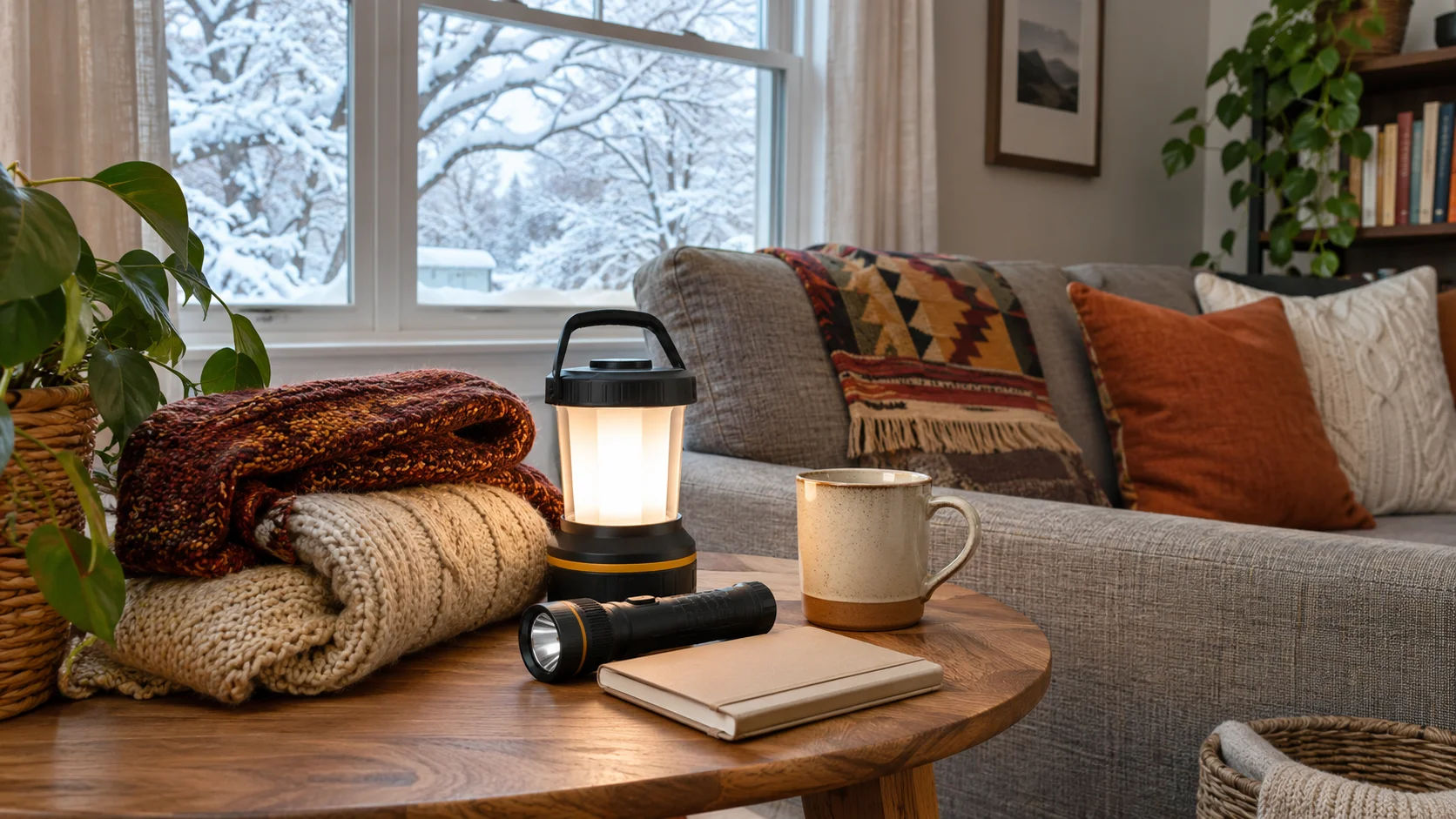
Keep blankets, warm clothing and a battery-powered light accessible. CDC recommends flashlights or battery lanterns rather than candles during a power failure. Think ahead about where you could safely stay if the home becomes too cold, particularly if someone is older or especially vulnerable to cold.

Source: [CDC winter storm safety](https://www.cdc.gov/winter-weather/safety/stay-safe-during-after-a-winter-storm-safety.html).

A fuel-powered generator must never run inside a home or garage, even with doors open. CDC says to operate one outdoors, more than 20 feet, about six metres, from windows, doors and vents. An apartment balcony should not be treated as a safe workaround.

Never bring a charcoal braai or camping gas stove indoors for heat or cooking.

Source: [CDC carbon-monoxide prevention](https://www.cdc.gov/carbon-monoxide/about/index.html).

**Your first small step**

Before the next cold spell, save your building’s emergency number, test the alarms and put a flashlight where everyone knows to find it. Then make a household plan for what you will do if the heating stops.

**Community question:** What is one thing you wish you had known before your first American winter?

This is general safety information, not a property inspection or a statement of local landlord requirements. Follow manufacturer instructions, local emergency guidance and building rules.

Read more →

Shared by a community member